

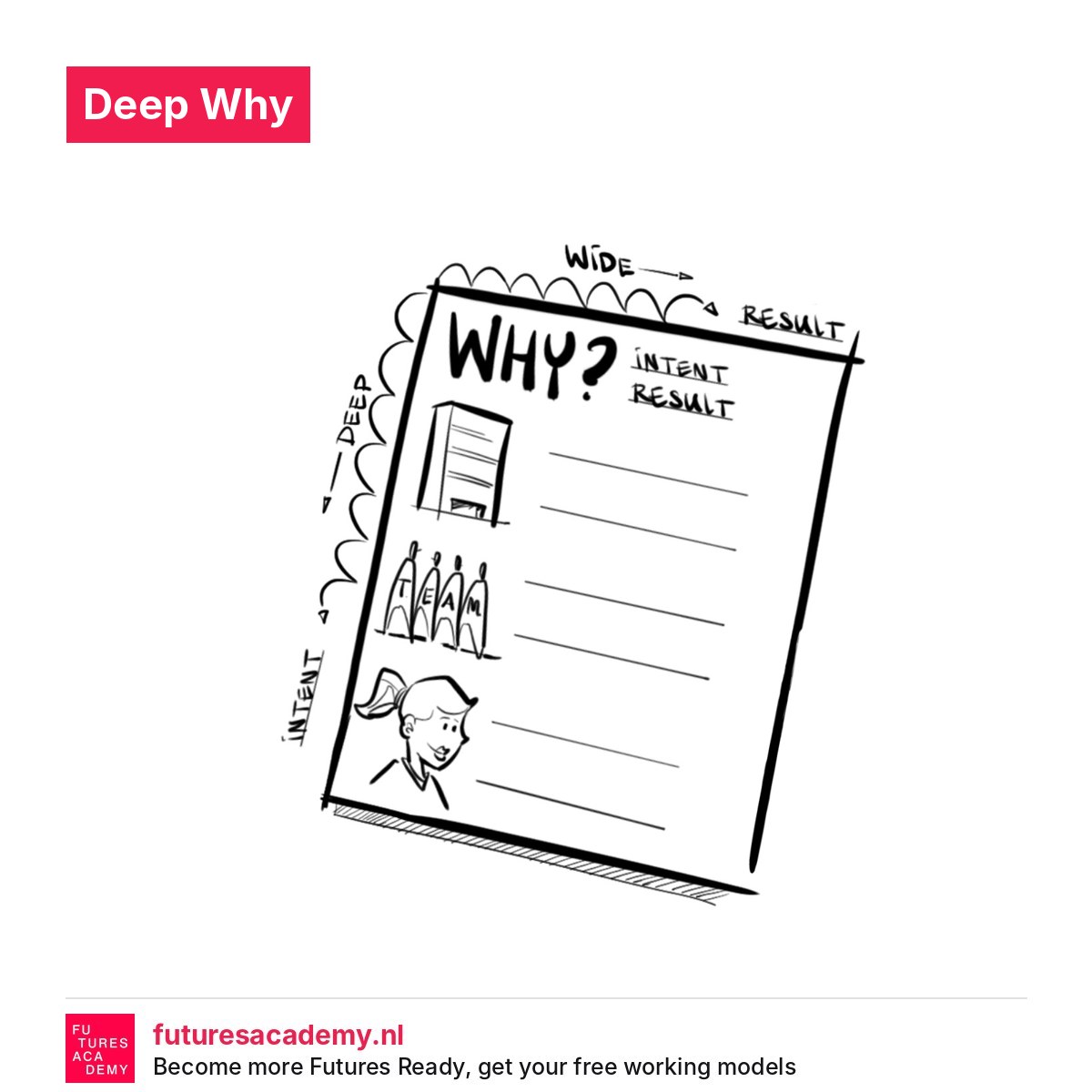
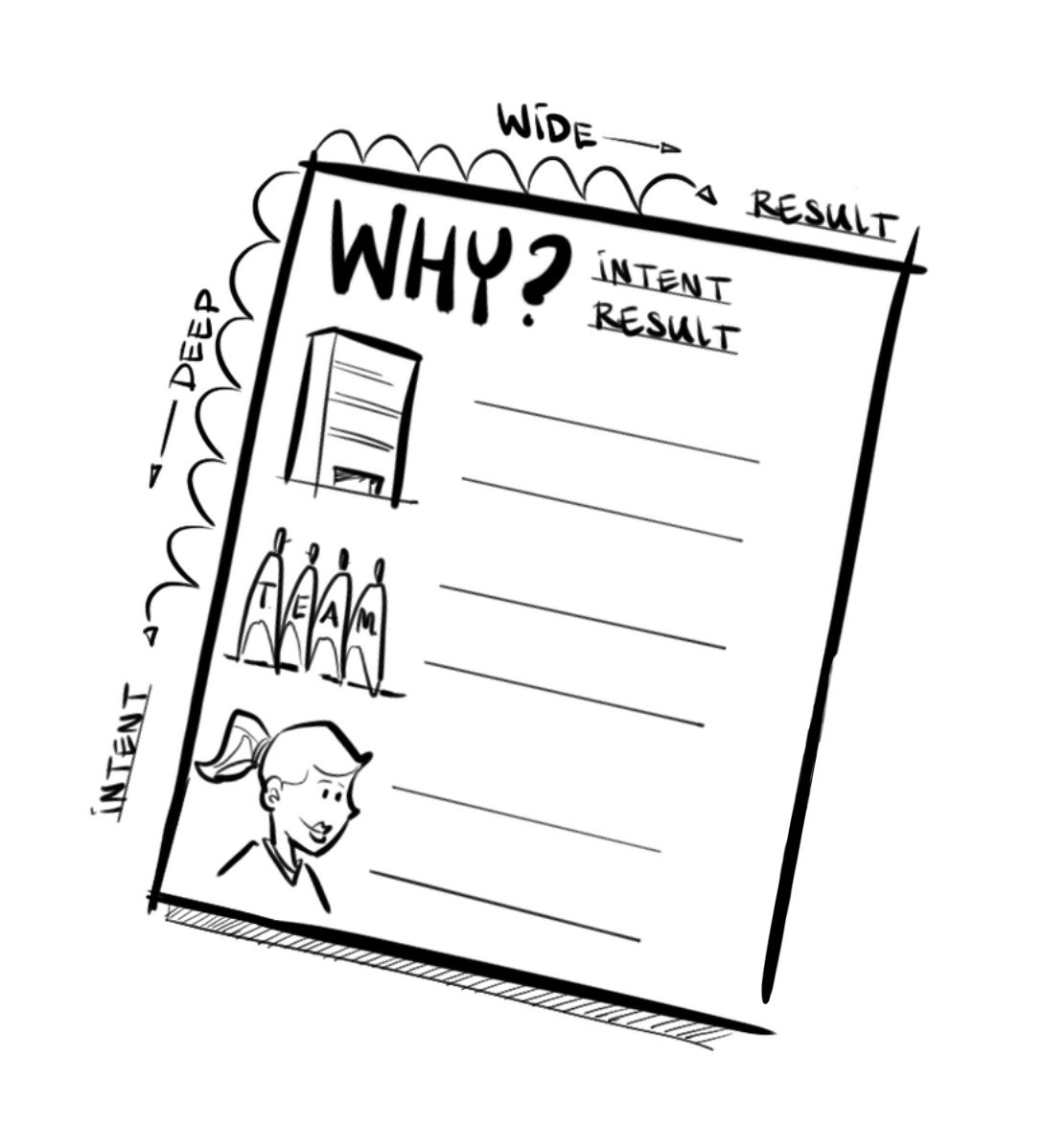
The 5 Whys in two forms. As Root Cause it is a problem solving technique, originally from Sakichi Toyoda: you keep asking along a chain until you reach the cause behind the symptoms. As Deep Why you ask exactly the same question five times, as self inquiry, until you get beyond the expected answer to your real motivation.
The Deep Why challenges your assumption that your first answer is also your real answer.
When to use
the Deep Why
With Root Cause the question changes with every answer and you build a logical chain of cause and effect. With the Deep Why the question stays exactly the same. That repetition quietens analytical thinking and turns your attention inwards.
Searching for cause
and/or intent
You ask one question: why. Then you choose a direction. With Root Cause you move along the top towards the result and look for the cause. With the Deep Why you go into the depth, towards the intent, and look for what really drives you.
The classic 5 Whys, originally devised by Sakichi Toyoda for problems in manufacturing. You look for the cause of a problem instead of only fighting the symptoms on the surface. All five questions start with why, but the wording changes with every answer. That way you build a logical chain of cause and effect.
You ask exactly the same question five times: why? That way you peel away the surface thoughts layer by layer, until you reach a deeper truth. The first answer is often the expected one: because it had to be done, or because it was in the diary.
Inspired by Hindu and Zen traditions, you can also use one single unchanging question. In the search for the Deep Why this works remarkably well to uncover hidden beliefs or your real motivation. You do not analyse, but first let a deeper answer surface before the question sounds again. The repetition quietens the analytical thinking shaped by your surroundings and turns your attention to yourself.
Simon Sinek, known for Start with Why, shows in a minute and a half why it starts with why. A good prelude to your own Deep Why.
How do you apply it?
- 1Explain the setup. Timing, roles, and why you ask the same question five times: to get beyond the socially expected answer.
- 2Sit down in pairs. The listener guides the conversation. If you like, put the chairs back to back.
- 3Ask the question. Always start with: Tell me, why… For example: why are you here today?
- 4Only say thank you. After every answer the listener only says: thank you. No reaction, no conversation.
- 5Repeat exactly the same question. Five times. The same answer, a new answer or silence: it is all fine.
- 6Swap roles. After about seven minutes. Make it clear when it is time.
- 7Share in the group. Let the pairs tell each other’s Deep Why to the group.

Tips from practice
- Choose your form beforehand: the Deep Why for the intent, Root Cause for cause and effect.
- Do not think too much. Let thoughts and feelings come by themselves, and do not push.
- It feels uncomfortable, and that is why it takes discipline. Stick to your role: no conversation.
- Turn the chairs around. Back to back, you avoid non verbal reactions from the listener.
- Let the listener tell the other person’s Deep Why to the group. That way one really listens, and the other can focus on the journey.
Twice five times why
This is how a conversation could go, in each of the two forms. An illustration, not a real record.
Deep Why · always the same question: why are you here today?
Root Cause · a new question each time: why do customers drop out?
The first answer is the expected one. The fifth often comes closer to the truth.
Every week one pioneer like Klarna
What did that organisation really do, and why? In ten minutes. With three reflection questions and a canvas to apply the move to your own challenge.
- 1new pioneer every week
- 30 minlive webinar, every other week
- €10per month, cancel any month



Possible next steps
Further reading
Good reads
- Start with WhySimon Sinek, 2009
- Find Your WhySimon Sinek, David Mead and Peter Docker, 2017
- Who Am I? (Nan Yar?)Sri Ramana Maharshi, 1923
- The Five WhysToyota tradition
Scientific background
- The What and Why of Goal PursuitsEdward L. Deci and Richard M. Ryan, 2000
- The Problem with 5 WhysAlan J. Card, 2017