
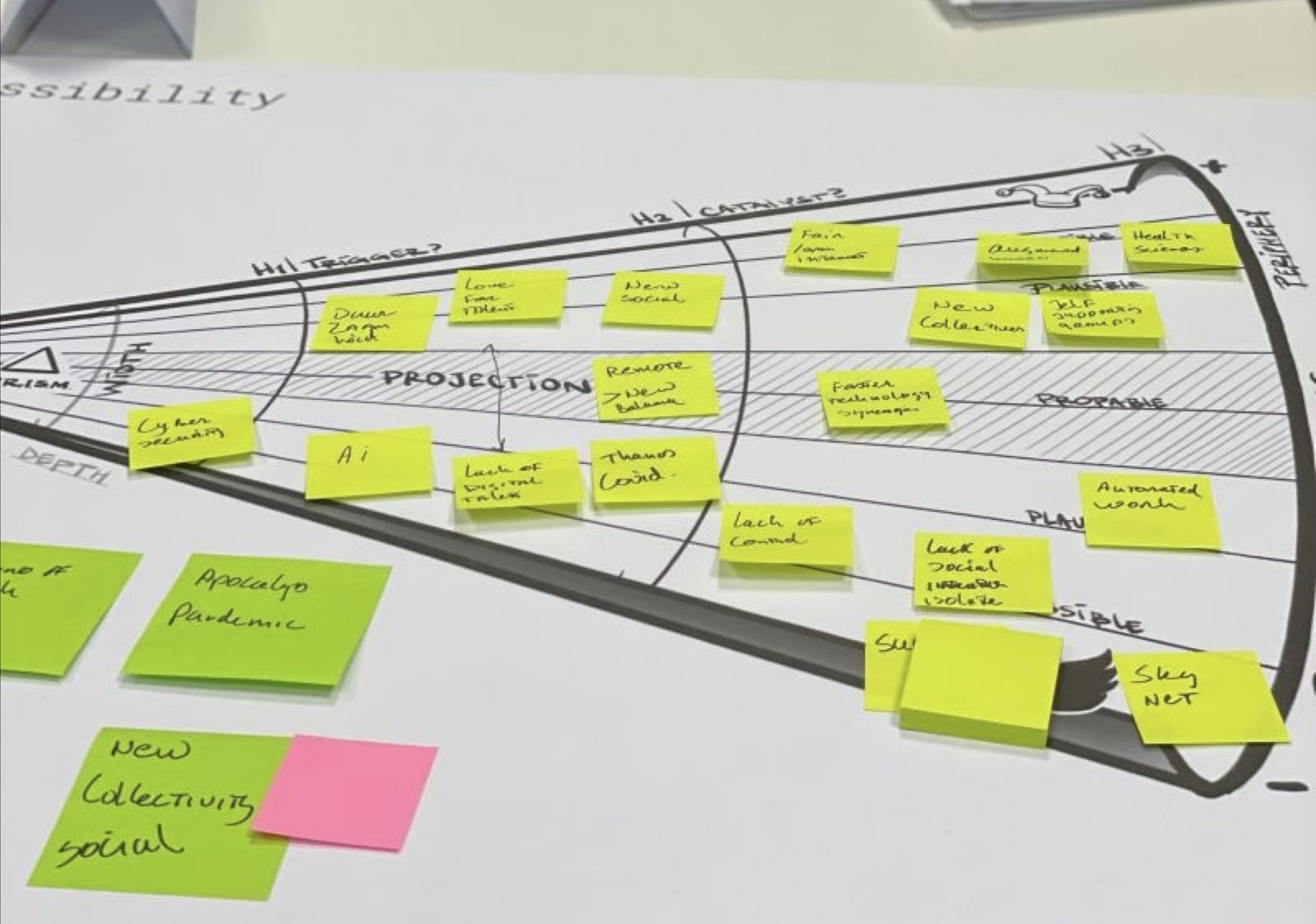
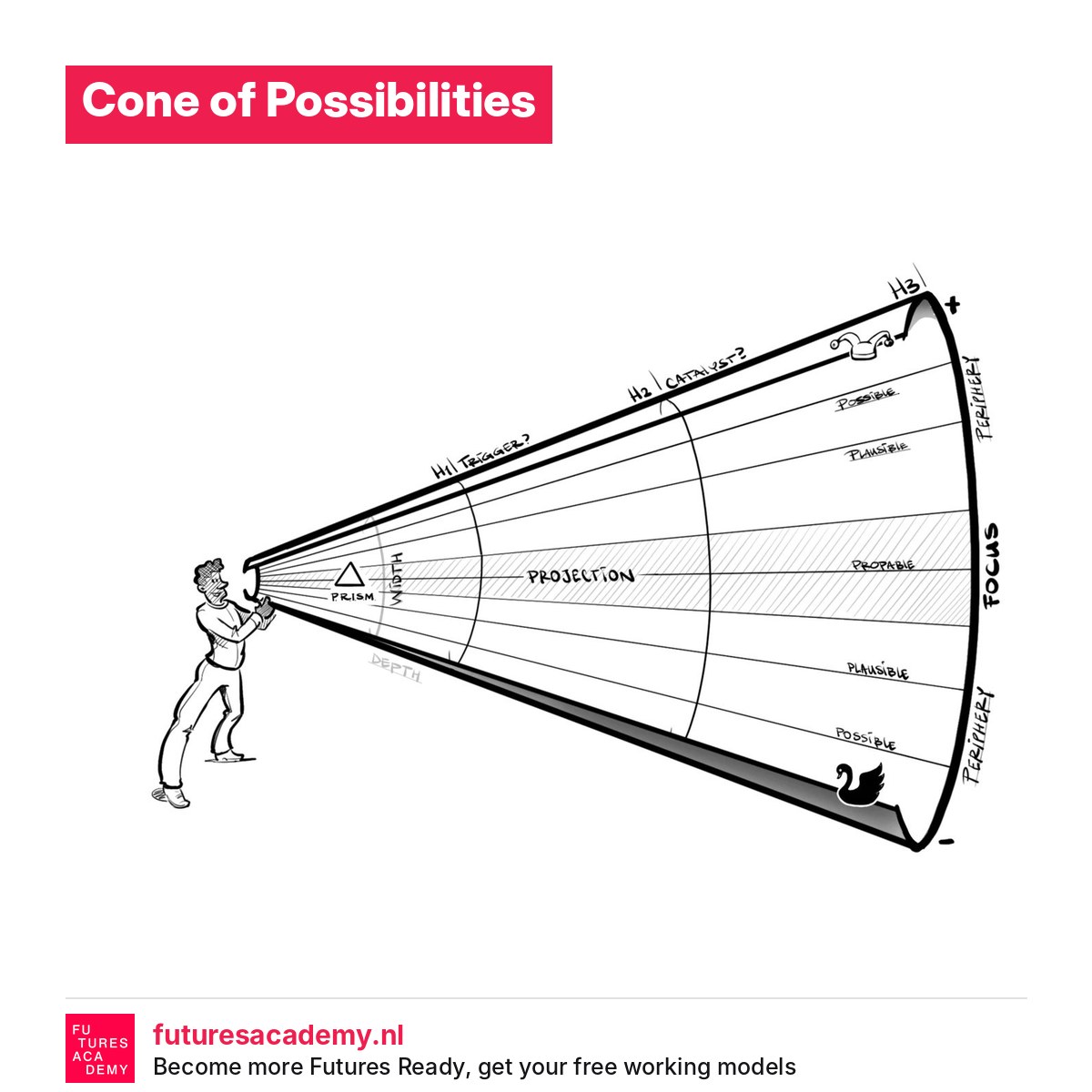
A model that arranges future events from your perspective by time, impact and probability. The further ahead you look, the more becomes possible. That is why it is a Cone. And the edges of the Cone are the limits of what you believe is possible.
The Cone challenges your assumption that the future is an extension of today, and teaches you to accept uncertainty.
When to use
the Cone of Possibilities
A trend list tells you what is happening. The Cone adds when it matters to you and how likely it is. And it pushes you beyond the obvious middle.
Horizons, impact
and probability
You read the Cone in four ways. From the prism you choose from which position you look. Along the Cone you ask when. Above or below the centre line you ask what the impact is. From the middle outwards you ask how certain it is.
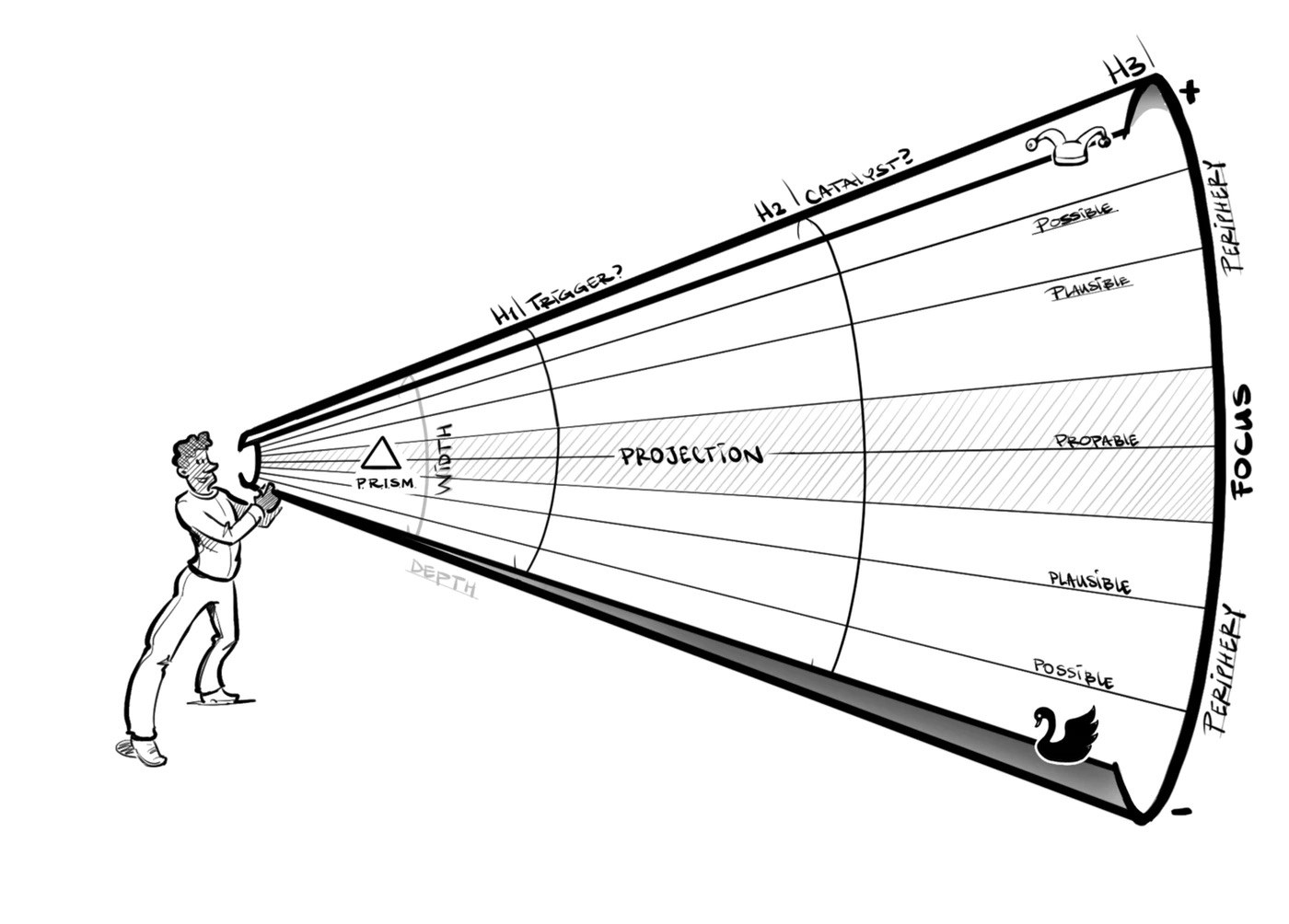
From which position are you looking? Your team, your organisation, your service, the market or society. The prism sets how wide and how deep you look.
What is already changing? Which events could affect you in the coming year?
What could speed up that change or steer it in another direction?
What does the world look like when the change has fully played out? You set the horizons yourself, to fit your question.
Which developments offer opportunities? They belong above the line, on the plus side.
Which developments bring risks? They belong below the line, on the minus side.
What happens if today’s trends continue? Example: interest rates stay around their current level, one or two percentage points up or down.
What could happen under certain circumstances? Example: interest rates quadruple.
What could technically happen, even if it seems unlikely now? Example: interest rates of seven or eight percent, not seen for decades.
What do you consider impossible? Interest rates of zero, or above twelve percent? This is where you meet your own limiting beliefs. Above the line they are called moonshots, below it black swans.
Silicon Valley forecaster Paul Saffo explains in just over a minute how to look at the future with the Cone: not at that one prediction, but at the space of what is possible.
How do you apply it?
- 1Choose your perspective. Your team, your organisation, your service, the market or society. Write it down as a title.
- 2Set your horizons. For example one year, three to five years and five to ten years. Choose what fits your question.
- 3Collect observations. Trends, signals and ideas from social, technological, economic, ecological and political shifts. One per note.
- 4Mark the impact. Opportunity or risk? Opportunities above the line, risks below it. Use notes in two colours.
- 5Place it in time. When does it matter most to you: horizon 1, 2 or 3?
- 6Place it by certainty. Probable, plausible, possible or impossible?
- 7Look for patterns. Cluster the notes. Which themes or scenarios do you see emerging?
- 8Mark your preferred future. What do you actually want to happen, and where does that sit in your Cone? Expecting is not the same as wanting.
- 9Find your blind spots. Where is it crowded and where is it empty? The empty places are your blind spots.
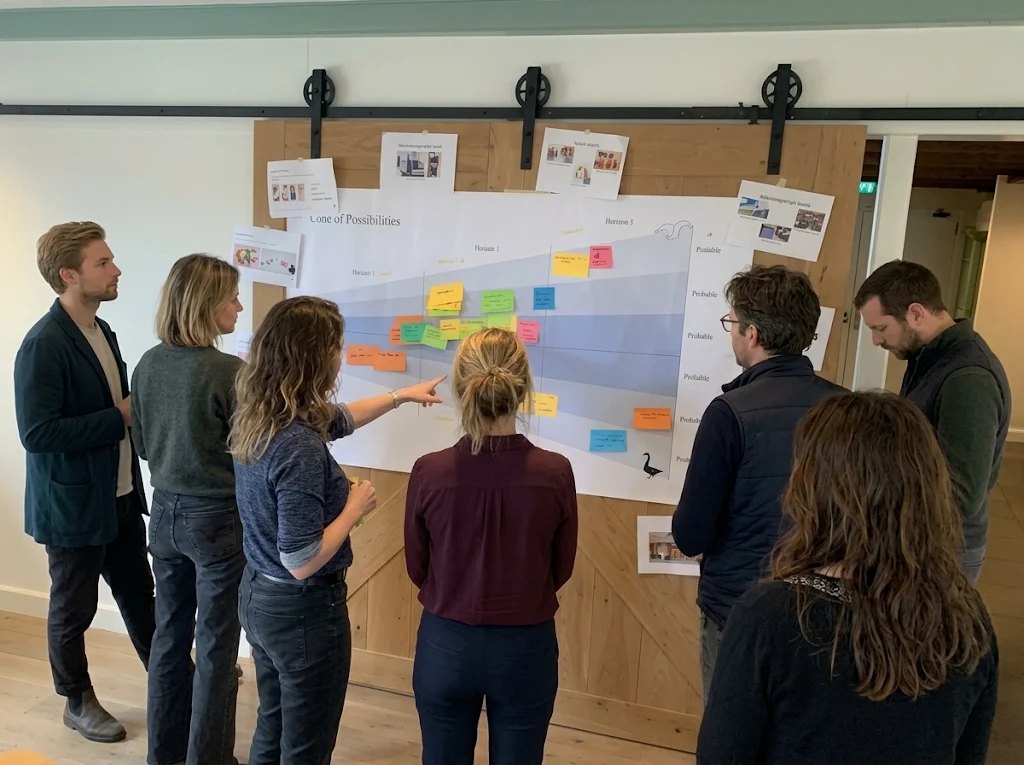
Tips from practice
- Startups put almost everything above the line. Challenge them to explore the risks as well.
- Financial institutions often put everything below the line. Lift them up towards the opportunities.
- Most teams stay close to today: horizons 1 and 2, in the probable middle. Push them towards horizon 3 and the edges.
- For every wildcard, ask: is this really impossible, or do you think it is impossible?
- Describe each event with an adjective, a noun and a verb. That makes it concrete.
- Add a fifth P, Preposterous: the wildcard you would normally wave away.
- Say “yes, and…” and build on each other’s ideas instead of judging them.
Klarna on the Cone
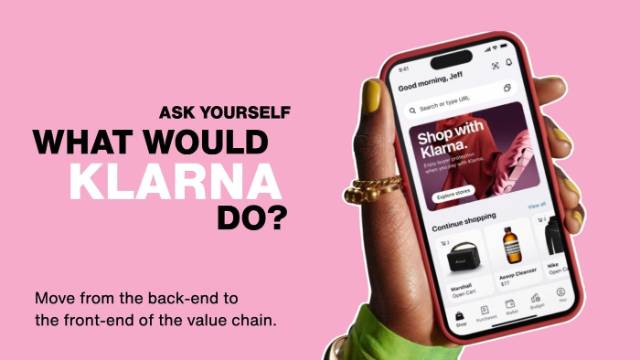
For years, paying was the dull last step of shopping online. Klarna looked further ahead and moved from the back to the front of the customer journey.
Perspective · from which position
When · from today to horizon 3
Impact · positive or negative
Likelihood · from the middle to the edges
On the Cone, payment looked like a probable back office facility. Klarna looked beyond the middle, towards an app where shopping and paying come together. And it took the negative side into account straight away.
Every week one pioneer like Klarna
What did that organisation really do, and why? In ten minutes. With three reflection questions and a canvas to apply the move to your own challenge.
- 1new pioneer every week
- 30 minlive webinar, every other week
- €10per month, cancel any month
Possible next steps
Further reading
Good reads
- Speculative Everything: Design, Fiction, and Social DreamingAnthony Dunne and Fiona Raby, 2013
- Designing Futures: Speculation, Critique, InnovationBenedikt Groß and Eileen Mandir, 2024
- Not Here, Not Now: Speculative Thought, Impossibility, and the Design ImaginationAnthony Dunne and Fiona Raby, 2025
Scientific background
- Norman Henchey, 1978. Early distinctions between alternative futures.
- A Generic Foresight Process FrameworkJoseph Voros, 2003